
Abstract (Draft)
Background: Supportive care interventions that enhance tolerance to chemotherapy and improve quality of life remain a critical unmet need in oncology. Valor Humani, a natural herbal supplement, was evaluated for its potential to improve functional outcomes and augment chemotherapy efficacy in advanced cancer patients.
Methods: A two-phase clinical study was initiated. Here we report the findings from Phase I, a six-month pilot trial with extended follow-up, involving patients with stage IV malignancies across diverse tumor types. Patients received Valor Humani during remission intervals, concomitant with standard chemotherapy. Functional status, hematological and biochemical parameters, and quality-of-life metrics were assessed.
Results: Early improvements were observed in oral intake, weight gain, vitality, and tolerance to chemotherapy. The most pronounced benefits were noted among patients with gastrointestinal (GI) malignancies, where Valor Humani enhanced chemotherapy efficacy and reduced adverse effects. No supplement-related toxicities were identified, aside from minor taste-related discomfort. Final outcomes demonstrated significant improvements in quality of life, functional performance, hepatic function, hemoglobin, and hematocrit. At 12-month follow-up, 7 of 15 patients exhibited stable function and continued supplement use, reporting enhanced chemotherapy tolerance and no adverse events.
Conclusions: Valor Humani appears to be a safe and potentially effective supportive therapy in advanced cancer, particularly in GI malignancies. The supplement demonstrated synergistic effects with chemotherapy, reduced treatment-related toxicities, and improved systemic resilience.
Note: This manuscript is a draft. The present Abstract reflects only Phase I pilot results. Findings from Phase II (focused exclusively on GI malignancies) are currently being analyzed and will be incorporated into the manuscript in the coming week.
Introduction (Draft)
Cancer remains one of the leading causes of morbidity and mortality worldwide, with gastrointestinal (GI) malignancies contributing significantly to global cancer burden. While advances in systemic therapies such as chemotherapy have improved survival outcomes, treatment-related toxicities and impaired quality of life continue to pose major challenges for both patients and clinicians. Supportive interventions that can enhance therapeutic efficacy while mitigating adverse effects are urgently needed.
Humic substances, naturally derived organic compounds, have been investigated for their potential immunomodulatory, anti-inflammatory, and detoxifying properties. Valor Humani, a natural herbal supplement, represents a novel approach to supportive care in oncology. Preclinical toxicology studies have demonstrated safety at doses exceeding those intended for clinical use, supporting the initiation of early-phase clinical evaluation.
The present study was designed as a two-phase clinical investigation of Valor Humani in advanced cancer patients. Phase I, reported here, was conducted as a heterogeneous pilot study including patients with stage IV malignancies across multiple tumor types. The primary objectives were to evaluate safety, tolerability, and preliminary signals of efficacy, with particular focus on functional performance, laboratory biomarkers, and quality of life. Secondary objectives included assessing potential interactions with standard chemotherapy and identifying patient subgroups most likely to benefit.
Notably, during Phase I the most promising results were observed in patients with GI malignancies, prompting the design of Phase II to specifically evaluate this population in a more controlled setting.
Note: This Introduction is part of a draft manuscript. At present, it reflects the rationale and structure of Phase I only. The findings from Phase II (GI-specific cohort) are expected to be included in the finalized version of this article in the coming week.
Cancer treatment is considered one of the greatest challenges of the current century, as well as the next one. Over the past 40 years, there have been no significant breakthroughs in chemotherapy treatments that could dramatically extend the lives of cancer patients.
The author of this article has been following his mother’s struggle with cancer over the last 30 years, and has been a firsthand witness to the medical processes, hospitals, side effects, pain, and more struggles that held all the family during the time of sickness. Due to his work and expertise in oncological naturopathy, having treated over 1,200 oncology patients, the author has explored and found a new therapeutic approach using herbal formulations he developed. These formulas have been integrated into the oncological treatments of his patients. The author provides this treatment at the beginning of his path based on pre-clinical research that was conducted between 2015 and 2018 in various laboratories in Israel by leading scientists, including Dr. Raanan Margalit at the Science in action institute in kiriat waizmen in Nes Ziona, and Dr. Yehoshua Maor at the resorsixs labs at the technological park next to the Ein Kerem hospital in Jerusalem. After a major success in the lab area the next step was the clinical trials that were taking place with their results in this paper in front of you.
The earliest studies, carried out by Dr. Raanan Margalit in 2015, clearly demonstrated that the valor- humani herbal tinctures compound were highly effective against lethal cancer cells such as GBM (glioblastoma multiforme), lung cancer, and triple-negative breast cancer. Following this initial experiment, a comprehensive toxicity test was conducted to confirm that even at high doses, this compound remains safe and non-toxic.
Furthermore, a professional opinion was provided by Professor Amnon Prakash regarding the blood tests of the mice in in-vivo experiment, which did not show any abnormalities beyond the normal range. Based on this success, more advanced experiments were carried out by Dr. Yehoshua Maor, where different processes related to the anti-cancer activity of valor-humani were examined, and complex models were developed to demonstrate the compound’s action within cancer cells. These experiments unequivocally showed the following results:
- Valor- humani induces significant necrosis in cancer cells without harming healthy cells. Additionally, advanced BBB (blood-brain barrier) models were built to test the permeability of the compound through the blood-brain barrier, showing potential as a future treatment for GBM.
- A complex model of the intestinal barrier demonstrated that valor-humani can relax the TEER (trans-epithelial electrical resistance), allowing it to pass through the intestinal barrier and reach distant parts of the body, including liver and pancreatic cancers, which were tested on various cell lines and shown to be active compared to a control group treated with Carboplatin and Irinotecan.
These experiments laid a strong foundation for the concept that a targeted herbal treatment, personalized to each patient according to the type of cancer they have, can be integrated into their oncological care.
A fundamental premise underlying both clinical trials is that the dietary supplement Valor Humani was administered during a state of disease remission. This remission was confirmed through ultrasound imaging and blood tests, which indicated tumor stabilization or even regression. This fact serves as a comparative parameter supporting the hypothesis that the use of this nutritional supplement series may act as a barrier against cancer recurrence, while also exerting a direct effect on processes related to the primary tumor and its metastases.
Additionally, the pharmacokinetics of the valor-humani herbal extract compounds within cells were examined. The results from Dr. Yehoshua Maor’s experiment confirmed that valor humani compounds impact key pathways, such as e-cadherin and β-catenin, known to be involved in metastatic processes.
Following these promising pre-clinical studies results, we have received a couple of peer reviews from mutual colleges and prestigious professionals around the world, one them is Manuel Biazo PHD and Professor Santusi from the Siena university in Italy, both of them declared that the following pre clinical trials were found very impressing and promising for our coming future, also that their institute is interesting in any other research or information in the future regarding the valor-humani products development.
An additional expert opinion was provided by Dr. Jonathan Friedman, a senior scientist at the Weizmann Institute of Science and a world-renowned authority in cancer research. In his comprehensive assessment, Dr. Friedman affirmed that the studies were conducted with scientific rigor and at the highest level of quality. He emphasized that the results speak for themselves and strongly support the continuation of research in the clinical domain.
A decision was made to initiate a clinical pilot study in collaboration with institutions in Uzbekistan by Dr raufov F.M – from the “samarkand branch of republican specialized scientific and practical medical center of oncology and radiology” in Uzbekistan- samarkand.
Pilot Study Objectives and Methodology part one:
At the start of the discussions about the research, we reviewed the main objectives that would guide the study and the outcomes we hope to achieve. These goals are outlined in the agreement (a copy of the research objectives will be provided).
Before diving into the details, here is a brief explanation of the key ingredients of valor- humani and their significance:
Boswellia serrata:
A common plant in India and Pakistan from the Bosma family, close to the biblical Levona and known in the Ayurvedic Indian medicine as a cure for intestinal diseases, arthritis and osteoporosis. Studies show that the wood resin has an anticancer effect at the nucleus level of cell division. It attacks cancer cells and preserves healthy cells. It also appears to help reduce edema and swelling in the brain due to radioactive treatments and relieves the
symptoms and severe side effects that accompany that treatments. In addition, the resin works as a powerful analgesic, prevents infections and contributes to hormonal stabilization.
Field Bindweed – Convolvulus arvensis:
Field Bindweed is a plant belonging to the pterosaurs family. It is a climbing or creeping plant, found in fields and waste places and very prevalent in North America and the
northern hemisphere. The plant contains proteoglycans that are protein-derived derivatives that thanks to their structure, can enter the cell membrane. Studies have shown that it interferes with the development of new blood vessels. Without blood supply, cancerous growth shrinks and sometimes disappears. When the material was examined for different cancers, it turned out to have the same effect on most types of cancers. In addition, extracting from the mixture encouraged an increase in the number of lymphocytes, thus increasing the immune system activity against cancer.
Turmeric – Curcuma longa:
Curcumin -a active ingredient in the turmeric plant, has been shown to have anti-cancer activity and is known for his anti-inflammatory properties. Studies have shown that it can shrink cancer tumors and delay the growth of blood supply to malignant tumors such as skin cancer, breast cancer and colon cancer, and increase the killing processes of cancer cells in the uterus, lung, liver and even leukemia cells. Studies show that curcumin has the ability to inhibit the activity of a protein complex called NF-kappa B that increases the transcription of DNA molecules in the cell and is an essential factor for the development of cancerous and inflammatory mechanisms in the body. In this way, curcumin reduces the production of inflammatory mediators and cancer-causing agents in cases of lymphoma, ovarian cancer, skin cancer, colon cancer and brain tumors.
Initially, the formulation contained three primary herbs: Boswellia Serrata, Turmeric, and Field Horsetail. Later, Reishi and Scutellaria Barbata were added to enhance the active effects, based on existing research (details will be added to the bibliography). These herbs were incorporated into the clinical research prior to the first trial.
Based on the laboratory experiments described above, it was decided to carry out a clinical pilot trial as an initial step without a control group. The study was conducted at an academic hospital in Samarkand, Uzbekistan, a facility specializing in oncological treatments. The first phase of the trial focused on patients in advanced stages 3 and 4, who consented to participate, and this consent was recorded and appeared in the trial protocol. Each participant signed an individual agreement outlining the protocol tailored to their disease type, concurrent treatments, and any other relevant factors.
The pilot study began with patients suffering from various types of cancer, including breast cancer, uterine cancer, and tumors in abdominal organs such as the pancreas, liver, intestine, and rectum. Most of the participants had a Karnofsky performance status between 50% and 70%.
Research Goals:
The study focused on two main objectives:
- To test whether valor-humani can help patients fight their cancer and improve their overall health.
- To examine the impact of valor-humani on the tumors themselves.
Methodology:
- Evaluation of the Karnofsky performance status for each patient, including their quality of life, daily functioning, eating and drinking habits, weight stability, and sleep quality.
- Central blood tests focused on PSR, hemoglobin, platelets, ESR, kidney function, and liver function.
- Routine ultrasound testing.
Each patient had an individualized protocol according to their tumor type, metastasis, and concurrent treatments. The nutritional supplement, valor-humani, was used alongside the patient’s ongoing oncological treatments.
Expected Results:
We anticipate improvements in vital signs, such as hemoglobin levels, as demonstrated in lab and toxicity experiments. The supplement is safe for use even in severe conditions, and its impact on cancer cells, such as pancreatic cancer cells, has been shown to be significant. Pancreatic cancer, known for its aggressiveness, has one of the highest mortality rates, with patients typically surviving only between 2-6 months after diagnosis. If a patient survives longer than that, it is considered a miracle. However, our studies have shown that valor- humani compounds can kill cancer cells in lab tests, even those resistant to conventional treatments.
Furthermore, as we demonstrated in pre-clinical experiments, valor-humani tincture affects β-catenin, a crucial component in the metastatic process. Blocking β-catenin should prevent metastasis and even cause the regression of existing metastases. This can be tracked through normal blood test results, indicating the absence of cancer progression.
Pilot Study part two Objectives and Methodology :
The pilot study lasted for six months, and due to the positive outcomes of the first phase, it was extended to the second phase, which will last for one year, focusing on GI tract-related tumors (liver, pancreas, colon, rectum, and esophagus). The results from the first phase were most promising for patients with GI tumors.
The second phase includes 30 patients, with 15 in the treatment group and 15 in the control group. This phase will specifically focus on patients at stage 3 of cancer, without including stage 4 patients. The three main goals of this phase are to:
- Investigate whether valor-humani can help patients with GI cancer fight their tumors and extend their lives.
- Test whether valor-humani can have a direct effect on the tumors themselves.
- Assess whether valor-humani can influence the reduction of metastases in GI cancers.
The second phase will be conducted over a year, focusing only on GI cancers, with a more refined approach based on the promising results from the first phase.
Methodology
Study Design
A two-phase clinical study was conducted. The initial pilot trial lasted approximately six months, followed by an additional observation period of several months to monitor stability after study completion. In the pilot phase, the study population consisted exclusively of patients with stage IV or terminal cancer, encompassing a broad spectrum of tumor types located in various organs, with widespread systemic involvement. The rationale for this heterogeneous design was to evaluate any preliminary effect of the intervention and subsequently refine the study population in later phases.
Eligible participants included both male and female patients receiving standard treatments concomitantly with the investigational supplement of valor-humani products line. Importantly, administration of the supplement was restricted to patients in remission intervals between treatments. Despite the diversity of tumor types, the study population was primarily between the ages of 33 and 66, all in advanced stages of disease. The tumor spectrum included breast cancer, uterine cancer, gastrointestinal malignancies (esophageal, biliary tract, colorectal, hepatic, renal, pancreatic), all type of GI tumors, as well as lymphoma and Hodgkin’s lymphoma with cerebral metastases.
As this was the first clinical investigation in a series evaluating the nutritional supplement of valor-humani compounds, broad inclusion was necessary to generate preliminary efficacy and safety data. The findings were intended to guide subsequent trials by refining patient selection, identifying target subpopulations, and delineating the potential scope of therapeutic benefit—particularly regarding life extension, improved quality of life, tumor regression, and disease stabilization, all without adverse effects.
Study Instruments and Criteria
Inclusion criteria: Adults aged 25–75 years.
Exclusion criteria: Patients with obstructive processes in the biliary tract, hepatic ducts, or gastrointestinal tract that impair circulation and metabolism; or unrelated comorbid surgical/medical conditions precluding study participation.
Randomized Controlled Trials (RCTs)
Efficacy and safety were evaluated using a randomized controlled trial framework. In herbal medicine, standard adult dosing typically ranges from 5–20 mL TID (three to four times daily) of liquid tincture. For the present study, the valor-humani compound was administered at 25 mL TID at relatively consistent intervals. Toxicology studies indicated no risk at substantially higher doses. Therefore, a “boost” protocol was implemented: once weekly, for three consecutive days, the dose was tripled to 60 mL per administration, after which the standard dosing schedule was resumed.
Observational Assessments
Monthly in-person evaluations were conducted by the treating oncologist at the hospital’s oncology department. Each visit included: (1) patient interviews to assess psychological well-being, fatigue, sleep quality, appetite, and tolerance of the supplement; (2) review of laboratory blood tests; and (3) functional assessment using the Karnofsky Performance Status (KPS) scale.
Measurement and Evaluation Systems
Monitoring included hematological and biochemical parameters (ESR, hemoglobin, hematocrit, hepatic and renal function tests), monthly ultrasonography, and longitudinal recording of individual Karnofsky scores.
Rationale for Instrument Selection
The chosen instruments emphasized qualitative outcomes, as the current stage of research focused on quality rather than quantitative endpoints. Blood tests and imaging studies provided objective data on tumor burden (regression or stabilization), while the Karnofsky scale offered insight into functional capacity and quality of life, both defined as primary study objectives.
Pilot Study – Phase II: Focus on Gastrointestinal Tumors (GI)
Study Design
Based on findings from the first pilot, a second phase was initiated in September 2024, lasting one year. This trial included 30 participants, divided equally into treatment (n=15) and control (n=15) groups. Only patients with gastrointestinal (GI) malignancies—ranging from esophageal to lower abdominal sites—were enrolled. Unlike the first pilot, this phase included patients with stage III disease rather than terminal stage IV disease. As before, the supplement was administered only during remission intervals between standard treatments, using the same dosing and boost protocol.
Participants ranged in age from 30 to 71. The clinical team expanded from one physician to three oncologists, all supervised by Dr. Farkhod Raufov, head of the oncology department in “samarkand branch of republican specialized scientific and practical medical center of oncology and radiology” in Uzbekistan- samarkand. Follow-up visits occurred bi-monthly and included laboratory testing, patient interviews, imaging studies, and KPS evaluation in both experimental and control groups.
Study Objectives
The primary endpoints mirrored those of the first pilot: survival extension, improvement of quality of life, and reduction of tumor size. In addition, this phase specifically investigated the supplement’s potential to arrest or regress GI-related metastases.
Research Instruments
- RCT protocol: Dosing followed the same standard and boost regimen as described in Phase I.
- Observational assessments: Bi-monthly interviews and evaluations, including tolerance, psychosocial status, and functional capacity.
- Measurement systems: ESR, hemoglobin, hematocrit, hepatic and renal function, monthly ultrasonography, and continuous Karnofsky assessments with direct comparison to the control group.
Rationale
The methodology emphasized qualitative outcomes, with blood tests and imaging serving as primary measures of tumor dynamics, while the Karnofsky scale captured functional and quality-of-life effects. Continuous comparison with the control group enabled assessment of treatment-related improvements. The working hypothesis posited that normalization of ESR, hemoglobin, and liver function markers would correlate with interruption or cessation of metastatic progression.
Results
Pilot Study – Phase I
Early findings (2 months):
Within two months of initiating the study, notable improvements were observed in vital functional parameters, including oral intake, weight gain, and overall vitality. Enhanced tolerance to chemotherapy was recorded, with no evidence of drug–supplement interactions or contraindications when the valor-humani supplement was administered concomitantly with chemotherapy.
Interim findings:
The most promising responses were observed among patients with gastrointestinal (GI) malignancies and their associated metastases. Combined administration of Valor Humani with chemotherapy appeared to enhance treatment efficacy and significantly reduce chemotherapy-related adverse effects. No adverse effects were reported from supplement use, apart from minor discomfort due to its strong taste. Importantly, rather than diminishing chemotherapy effectiveness, the supplement appeared to potentiate its impact.
Final findings:
Marked improvements in quality of life and functional status were documented among patients with GI tumors. Valor Humani demonstrated optimal efficacy when combined with chemotherapy, mitigating treatment-related toxicities and enhancing patient vitality, appetite, and resilience. Hematological and biochemical analyses confirmed substantial improvements in hepatic function, hemoglobin levels, and hematocrit.
End-of-study recommendation:
Based on these findings, it is strongly recommended that Valor Humani be considered as a supportive adjunct in patients undergoing anticancer therapy, including those with advanced stage IV disease. Its use was associated with enhanced chemotherapy efficacy, strengthened systemic function, reduced treatment-related toxicities, and tumor reduction, particularly in GI malignancies and metastases.
Follow-up at 12 Months Post-Trial
Of the 15 patients enrolled, 8 were no longer living at the time of follow-up. The 7 surviving patients demonstrated stable function and most continued to independently use the Valor Humani supplement series. These patients also expressed willingness to participate in future trials. No adverse or harmful effects related to supplement use were reported, while significant benefit was observed in terms of chemotherapy tolerance and synergistic efficacy.
Attrition details:
- 1 patient withdrew due to non-cancer-related medical conditions.
- 2 patients voluntarily discontinued participation approximately two months after initiation.
- 2 patients, despite showing initial improvements, withdrew for unclear reasons after two months.
- 3 patients died either during the study or shortly thereafter.
Blood test outcomes:
Laboratory monitoring confirmed normalization or substantial improvement in multiple indices, including hemoglobin, hematocrit, and liver function markers, consistent with enhanced systemic resilience and disease stabilization.
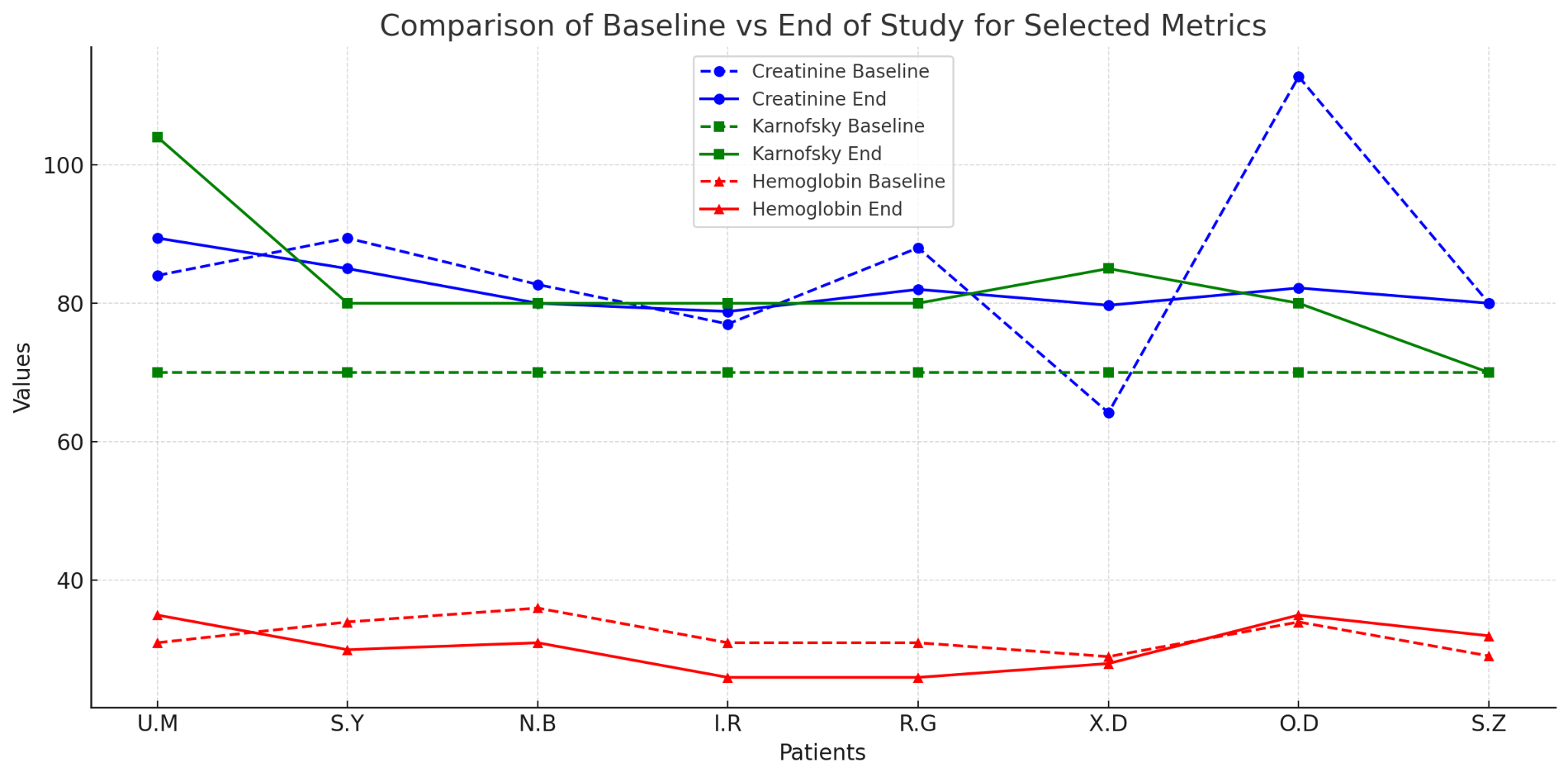
Evaluation of Clinical Outcomes in Advanced Stage IV Cancer Patients Undergoing Combined Treatment
This graph presents the clinical outcomes of eight advanced Stage IV cancer patients, focusing on changes in renal function (creatinine levels), quality of life (Karnofsky performance status), and hemoglobin levels before and after a combined treatment regimen.